Author: montebaco

Rueda Designation of Origin

In the heart of Castilla y León, the Rueda Designation of Origin is a clear example of how a terroir and a specific grape variety can give rise to an oenological identity that crosses borders.

Rueda has gone from being a well-kept secret of Castilla y León to one of the most valued denominations of origin internationally. Located in the Autonomous Community of Castilla y León, this wine region extends over 74 municipalities in the provinces of Valladolid, Segovia and Ávila.

The history of wine in the Rueda region dates back more than a thousand years, to the time of the reconquest of Muslim territories in the eleventh century. Historical chronicles relate that after the reconquest of Valladolid and the lands of Castile and León, Christian monks and clerics promoted the planting of vineyards to supply themselves with wine for the celebration of mass and for general consumption. It was in this context that viticulture began to take hold in the region of Rueda, taking advantage of the extreme climate of the Castilian plateau and the characteristics of stony soils that were ideal for the production of grapes.

During the Middle Ages, wine production in Rueda experienced a great boom. The monks, who tended the vineyards and produced wine, were in charge of preserving and improving the methods of cultivation and winemaking, becoming true guardians of a winemaking tradition in constant evolution.

If we talk about Rueda, we cannot fail to mention the Verdejo grape, the real protagonist of this D.O. Although it is believed that Verdejo was brought to the region by the Mozarabs in the Middle Ages, the variety adapted in such a way to the climate and soil of Rueda that in a few centuries it developed unique characteristics that made it a native grape of the area.

Verdejo is a grape with thick skin and intense flavor, ideal to resist the cold winters and extremely hot summers of Castilla y León. This climate of contrasts, together with the cool summer nights, allows the grapes to maintain their acidity and freshness, achieving wines with a perfect balance between sugar and acidity. For centuries, local producers perfected the art of working this grape, creating white wines with a unique character: fresh, aromatic and full of fruity and herbaceous notes that capture the spirit of their land.

At the end of the nineteenth century, the European wine industry suffered a devastating plague: phylloxera. This pest significantly affected the vineyards of Rueda, destroying a large part of the plantations. However, from this crisis came an opportunity to redefine the region’s wine industry. Winegrowers began to replant the vineyards with grafts of resistant varieties, and studies were initiated to enhance the Verdejo variety and improve winemaking methods.

It was during this time of reconstruction that the Rueda region began to gestate what would later become its denomination of origin. As time went by, it became clear that white wines, especially those made from Verdejo grapes, were the ones that best adapted to the terrain and climate, resulting in wines with personality and an authentic flavor.

The decade of the seventies marked a before and after in the history of Rueda wines. Until then, the wines of this region were mainly consumed locally, but a growing interest in quality white wines led producers in the area to organize themselves to protect and promote their products.

In 1980, the Rueda Designation of Origin was officially recognized, being the first D.O. of Castilla y León. This recognition not only meant protection for the wines of the region, but also established quality standards that ensured the authenticity of their products. Since then, the D.O. Rueda has been committed to the production of high-quality wines, becoming one of the main exporters of white wine in Spain.

Montebaco Rueda is a perfect example of the wines made in this Denomination for its balance with the main grapes of this Denomination, Verdejo and Sauvignon, its bright tone and its aromatic intensity. A fresh wine, which also represents the essence of this land of vineyards, where the climate and a unique soil contribute to creating wines of exceptional quality.

Today, the Rueda Designation of Origin continues to evolve without losing sight of its roots. Despite technological changes and the expansion of its market, the D.O. Rueda maintains a deep respect for traditional cultivation and winemaking techniques. At the same time, the region has embraced innovation, allowing winemakers to experiment with modern methods to improve the quality and diversity of their wines.

In addition to the traditional Verdejo, Rueda also produces wines with other varieties, mainly Sauvignon blanc, but also Palomino fino, Viura, Chardonnay and Viognier, offering a range of white wines that satisfies a wide variety of palates. Internationally, Rueda wines have gained prestige for their quality and price-quality ratio, becoming an increasingly popular option in markets as demanding as the United States and the United Kingdom.

Since 2008, this Designation has also recognised red and rosé wines with their different categories: young, crianza, reserva and gran reserva, with a predominance of the Tempranillo grape.

The next time you toast with a D.O. Rueda wine, remember that you are tasting centuries of history, a heritage of flavor and a sample of the Castilian spirit. Because deep down, each glass is a tribute to time, the land and the passion for good wine. Bless you!

Valbuena de Duero

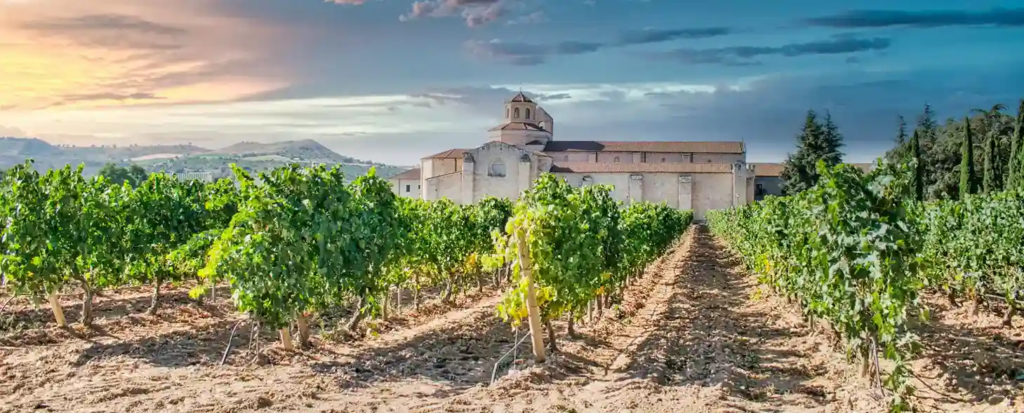
Valbuena de Duero is a small municipality in the province of Valladolid, located in the autonomous community of Castile and León. This unique village is nestled on the right bank of the Duero River, in the heart of the Ribera del Duero Designation of Origin, one of the most renowned wine-growing areas in Spain and the world.

Valbuena de Duero’s close relationship with wine production is a distinctive feature of its history, culture and economy, becoming a benchmark within the wine industry both nationally and internationally.

The origin of viticulture in Valbuena de Duero and in the Ribera del Duero dates back to Roman times. The Romans already cultivated vines in this region due to the favorable climatic and geographical conditions, which provided an ideal environment for the cultivation of grapes. However, it was in the Middle Ages when the monks of the Monastery of Santa María de Valbuena, founded in the twelfth century by the Cistercian order, began to give a more structured and significant boost to wine production in the area.

The monastery, which is located in the vicinity of Valbuena de Duero, played a fundamental role in the expansion of viticulture in the region. Cistercian monks introduced advanced cultivation and production techniques, which improved the quality of the wine. In fact, this monastery was a key centre in the management and organisation of the vineyard, favouring the development of the wine culture that has lasted to this day.

The geographical location of Valbuena de Duero offers exceptional conditions for vine cultivation. The extreme continental climate, characterized by long, cold winters and hot, dry summers, together with the considerable altitude (between 700 and 900 meters above sea level), creates an ideal environment for the growth of high-quality grapes. The considerable thermal amplitude between day and night during the ripening of the grapes is a crucial factor that favors the accumulation of sugars and phenolic compounds in the grapes, resulting in wines with body, structure and a marked acidity.

Soil also plays a fundamental role. The vineyards of Valbuena de Duero are located on mainly limestone soils, with the presence of sand and clay. These soils, poor in nutrients, force the vine to deepen its roots in search of water, which favours the obtaining of more concentrated grapes, which provide greater intensity and complexity to the wines produced in the area. In addition, the Duero, which crosses the municipality, influences the regulation of temperature and humidity, contributing to the perfect balance between climatic and edaphic factors.

Valbuena de Duero is located within the Ribera del Duero Designation of Origin, one of the most prestigious in Spain. This denomination extends over about 115 kilometers on both sides of the Duero River, covering the provinces of Valladolid, Burgos, Segovia and Soria. Ribera del Duero is renowned for the production of high-quality red wines, made mainly from the Tempranillo grape variety, known locally as Tinta del País or Tinto Fino.

The wines of Ribera del Duero, and therefore those of Valbuena de Duero, are appreciated for their depth, concentration and elegance. The reds are characterized by their intense color, a robust tannic structure and a great capacity for aging in oak barrels. These wines excellently combine fruity notes with the spicy and smoky touches provided by aging in wood.

Valbuena de Duero is home to some of the most emblematic wineries in the Ribera del Duero. Bodegas Montebaco, founded in 1981, has been recognized in the production of wines of excellence, standing out for its ability to create wines that combine power, elegance and an extraordinary aging capacity. Its best-known red wine brands are Montebaco de Finca, CaraNorte, Montebaco Selección Especial and Semele, with wide national and international recognition.

The Monastery of Santa María de Valbuena, restored and converted into a reference center for wine tourism, also houses the headquarters of the Las Edades del Hombre Foundation, dedicated to the promotion of the cultural and artistic heritage of Castilla y León. This space offers a unique blend of history, art, and wine, making it a must-stop for visitors to Valbuena de Duero.

Valbuena de Duero is a town deeply rooted in the culture of wine, where the winemaking tradition has been passed down from generation to generation. Its link with the Ribera del Duero, the quality of its vineyards and the presence of iconic wineries such as Bodegas Montebaco, have placed it as a benchmark in the wine industry.

Montebaco Winery

Bodegas Montebaco, located in the heart of the Ribera del Duero, is the result of a history of passion, dedication, and a constant search for excellence.

Since its inception, this family-run winery has evolved to become a benchmark for wine in Ribera del Duero, known for its meticulous approach, respect for tradition, and innovative take on the art of winemaking.

The history of Bodegas Montebaco begins in 1981, when Manuel Esteban, together with his wife Mª Ángeles Martín de la Rosa, decided to take a decisive step towards the creation of their own wine. Located on the Monte Alto Estate, between the municipalities of Valbuena de Duero and Pesquera de Duero, in Valladolid, the winery is located in one of the most privileged areas for viticulture in Spain. From the beginning, Manuel and Mª Ángeles were clear that they wanted to create unique wines that captured the essence of the land and transmitted the passion they felt for wine.

The Finca Monte Alto is one of the historic properties in the province of Valladolid, with origins that date back to the time of the monasteries, when the Cistercian Order arrived in Spain, also introducing the culture of wine. Near the estate, in San Bernardo, is the Monastery of Santa María de Valbuena, which belonged to this religious order.

Like many success stories, the Estebans faced significant challenges, from sourcing different clones of Tempranillo, to adapting the vineyards to the climatic conditions of the area, to perfecting winemaking methods. But the perseverance and enthusiasm for viticulture of Manuel and Mª Ángeles paid off, and in 1994 the first vintage of Montebaco was marketed with a production of 33,000 bottles, marking a milestone as a classic wine of the Ribera del Duero.

What makes Bodegas Montebaco special is its philosophy based on respect for the land. The winery has more than 50 hectares of its own vineyards, mainly cultivated with the Tempranillo variety and others such as Merlot, Garnacha and Malbec. Organic viticulture practices are applied, minimizing the use of pesticides and herbicides and encouraging the use of organic fertilizers. The winery seeks to respect the natural balance of the vineyard, allowing the plants to grow in a healthy and natural way, which is reflected in the quality of its grapes.

The Bodegas Montebaco team, led by the new generation of the Esteban family, have managed to create wines with a unique personality that reflect both the character of the terroir and the creativity and know-how of its winegrowers and winemakers. Each bottle of Montebaco is a true reflection of this constant search for excellence and the distinctive personality of its vineyards.

The Montebaco family of wines distinguishes itself from the classic offer of the Ribera del Duero (young, crianza, reserva…) by focusing more on the origin of the grape and the production process:

Montebaco de Finca is the winery’s flagship wine, it spends a longer time in barrels, which gives it a more traditional and representative style of the Ribera del Duero.

Montebaco Special Selection is produced only in vintages that present the optimal conditions for its production, with a very limited production.

Montebaco Parcela Cara Norte comes from a single plot cultivated through organic farming. This plot is located on a hillside with an altitude of close to 900 meters.

Montebaco Semele is a wine made with 95% Tempranillo grapes and 5% Merlot, aged for 12 months in barrels.

Montebaco Rosado is made with grapes of the Merlot variety (between 25% and 50%) complemented with Tempranillo.

Montebaco Rueda is a white wine made with Verdejo and Sauvignon grapes selected in the Rueda Designation of Origin.

The winery has a modern and functional design, is spacious and equipped with cutting-edge oenological technology. All this is located in a renovated one-storey building, which once housed the dairy and several agricultural dependencies of the farm.

The Tempranillo grape

The Tempranillo grape, one of the most emblematic and appreciated varieties, has gained worldwide recognition thanks to its unique characteristics and versatility in the production of high-quality wines. With a rich history and a significant presence in some of the most prestigious wine regions, this grape is a true treasure trove of viticulture.

The name “Tempranillo” comes from the word “early”, because this grape ripens earlier than many other varieties. Although the name Tempranillo is the best known, this grape is also known by other names in different regions of Spain and the world. In La Rioja, it is called “Tinta del País”, while in Ribera del Duero it is known as “Tinto Fino”. In Portugal, particularly in the Douro region, it is known as “Tinta Roriz” and in some areas of the Alentejo it is called “Aragonês”.

The Tempranillo grape is a thick-skinned red variety, which contributes to the intensity of color in the wines it produces. Tempranillo bunches are usually medium-sized, with spherical berries of a dark blue to bluish-black color. This grape adapts to various climatic conditions, although it prefers climates with warm days and cool nights, which favors a slow and balanced ripening of sugars and acids.

Wines made with Tempranillo tend to be medium to full-bodied, with moderate acidity and varying levels of tannins, depending on the winemaking style. Its aromatic profile is complex and can include notes of red and black fruits, such as cherries, plums, and blackberries, along with undertones of tobacco, leather, vanilla, and spices, mainly when aged in oak barrels.

The Tempranillo grape is prized for its ability to produce a wide range of wine styles, from young, fruity wines to robust, long-lived wines. In Ribera del Duero, it is common to find Tempranillo wines that have been aged in oak barrels, which adds complexity and depth to the aromatic and taste profile.

One of the most outstanding properties of Tempranillo is its balance between acidity, tannins and alcohol, which makes it suitable for both single-varietal wines and blends. In the Ribera del Duero, the Regulatory Council allows a percentage of blending with Cabernet-Sauvignon, Merlot, Malbec and Garnacha Tinta or, Albillo, the only authorized white.

An example is our Semele red wine, which has a percentage of 90% Tempranillo and 5-10% Merlot.

One of the characteristics of the Tempranillo grape is that it has a good aging capacity. The Reserva and Gran Reserva wines of the Ribera del Duero are classic examples of how this grape can develop complexity and elegance over time, acquiring notes of dried fruits, spices, tobacco and leather that complement the flavors of ripe fruits.

Spain is the leading producer of Tempranillo grapes, with the regions of La Rioja and Ribera del Duero leading the way in terms of quality and prestige.

Ribera del Duero produces Tempranillo wines known for their intensity and structure. Wines tend to be more robust and concentrated, reflecting the more extreme climate and diverse soils. Ribera del Duero wines have gained international recognition and raised the profile of Tempranillo as a world-class variety. Ribera del Duero wines are classified into four categories: young, crianza, reserva, and gran reserva, with an increasing emphasis on aging and complexity as you move up the rankings.

At Bodegas Montebaco, Tempranillo is a fundamental pillar of our wines, forming 100% of Montebaco de Finca, Montebaco CaraNorte, Montebaco Selección Especial and with a very high percentage of red Semele and Montebaco Rosé.

The Tempranillo grape is a fundamental pillar of Spanish viticulture and one of the most versatile and appreciated grape varieties worldwide. Its various names reflect its rich history and its adaptability to different regions and winemaking styles. With its ability to produce balanced and complex wines, from young and fruity to aged and sophisticated, Tempranillo continues to captivate winemakers and wine lovers alike.

Ribera del Duero Designation of Origin

The Ribera del Duero Designation of Origin is one of the most prestigious and recognized in the world of wine, at an international level. Located in the Autonomous Community of Castilla y León, the D.O. Ribera del Duero extends along the basin of the Duero River, covering part of the provinces of Burgos, Soria, Segovia and Valladolid.

This appellation has established itself as synonymous with quality and excellence in wine production, standing out mainly for its robust and elegant reds and with a rich history dating back centuries.

The history of wine in the Ribera del Duero can be traced thanks to the archaeological remains of the Pintia area, in Padilla de Duero, near Peñafiel, where remains of the Vaccea, Roman and Visigothic cultures have been found, as well as evidence of winemaking activity in this area for 2,500 years.

However, it was during the Middle Ages that viticulture began to flourish, boosted by the work of monasteries, which played a crucial role in the development of viticulture in Ribera del Duero. The monks, with their knowledge and dedication, improved the techniques of cultivation and winemaking. This monastic tradition contributed significantly to the consolidation of wine culture in the region.

Over the centuries, viticulture in the Ribera del Duero gained in importance and prestige, although it was at the end of the nineteenth century and the beginning of the twentieth that a real renaissance took place. The arrival of the railroad facilitated the transport and marketing of wines, allowing them to reach wider markets.

The official recognition of the Ribera del Duero Designation of Origin came in 1982. This milestone marked the beginning of a new era for the region, establishing rigorous production and quality control standards that ensured the prestige and excellence of its wines. The Designation has been key to the promotion and protection of the interests of the winegrowers and winemakers in the area, helping to position Ribera del Duero wines among the most appreciated in the world.

The Ribera del Duero Designation of Origin covers an area of around 115 kilometres along the Duero River, it is characterised by its extreme continental climate, with very cold winters and hot, dry summers. These conditions, together with the altitude (which ranges between 720 and 1,100 meters above sea level) and the diversity of soils, are key factors that contribute to the uniqueness and quality of Ribera del Duero wines.

The grape variety that predominates in the Ribera del Duero is Tempranillo, also known as Tinto Fino or Tinta del País. This grape is the basis of most of the red wines of the D.O. and is characterized by its ability to produce full-bodied wines, with good acidity and a remarkable aging capacity. In addition to Tempranillo, other varieties such as Cabernet Sauvignon, Merlot and Malbec are allowed in small proportions, contributing to the complexity and diversity of the wines.

The wines of Ribera del Duero are mainly red, although rosés are also produced, such as Montebaco Rosado. The reds are classified according to the time of aging in barrel and bottle. The “Roble” usually have a short period of aging in barrels, while the “Crianza” must be aged for at least 24 months, of which 12 must be in barrels. The “Reserva” and “Gran Reserva” require longer aging periods, guaranteeing greater complexity and sophistication in the final wine.

Ribera del Duero wines are known for their intense color, deep and complex aromas that can include black fruits, spices, tobacco, and leather, and their robust mouthfeel. These characteristics make Ribera del Duero wines highly appreciated by both critics and consumers.

Since its recognition as a Designation of Origin in 1982, Ribera del Duero has seen exponential growth in terms of quality and international recognition, cementing its reputation as one of the best wine-producing regions in the world.

Bodegas Montebaco is one of the wineries that have stood out within the Ribera del Duero Designation of Origin. Founded in 1987 by the Esteban family, Montebaco has cemented its reputation through a meticulous focus on quality and innovation, while maintaining a deep respect for tradition. Taking a sustainable approach, respecting the environment and promoting responsible agricultural practices, a perfect example of how the combination of terroir, tradition and modernity can give rise to great wines.

The Ribera del Duero Designation of Origin is the result of centuries of winemaking tradition, historical influences and a constant commitment to quality. Not only does this region produce some of the best wines in Spain, but it has also left an indelible mark on the international wine scene, standing out for its excellence and authenticity.

Montebaco Plot North Face

Montebaco Parcela Cara Norte is a red wine from organic farming, made entirely with Tempranillo grapes selected in the Ribera del Duero Denomination of Origin. It is a wine with great clarity of aromas and very defined estate notes: fresh black fruit and hints of blue fruit. Aged in barrels for 14 months.

In the setting of the Ribera del Duero, Montebaco Parcela Cara Norte is a wine that embodies the very essence of the terroir and the passion of its creators.

This wine is destined to captivate the senses of the most demanding palates. Its name, Parcela Cara Norte, evokes the image of the north-facing slopes of the vineyards, where the grapes find a perfect place.

The story of Montebaco Parcela Cara Norte begins in the vineyard, where the old Tempranillo vines, the emblematic variety of the region, cling to stony and clay soils in search of the nutrients and minerals that will give character and complexity to the wine.

The harvest in Montebaco Parcela Cara Norte is carried out by hand by expert hands who carefully select the grapes at their optimal point of ripeness. Each cluster is treated with the respect it deserves. This care is reflected in each bottle of Montebaco Parcela Cara Norte, where quality is the top priority.

In the winery, the winemaking process is a combination of tradition and cutting-edge technology. It is aged in carefully selected oak barrels, where it rests, developing complex layers of flavor and aroma, acquiring its distinctive personality and character.

Montebaco Parcela Cara Norte is the living testimony of Bodegas Montebaco’s commitment to quality, tradition and excellence, and an invitation to celebrate the beauty and diversity of the world of wine. In every sip, Montebaco Parcela Cara Norte tells a story of passion, dedication and love for the art of winemaking.

Montebaco Special Selection

The objective when making a Montebaco Selección Especial is to achieve the maximum expression and personality of the Monte Alto estate. Continuity between vintages is not sought, nor is it necessary to stick to a fixed varietal percentage.
Only seek excellence from extreme respect for the viticultural environment and simple and natural oenology. The result is a powerful but elegant, complex wine, with great character and good storage capacity. Aged in barrels for 14-18 months.

Each bottle of Montebaco Selección Especial is a living testimony of the craftsmanship and meticulous dedication that characterizes this family winery. From the selection of the grapes to the meticulous aging process in oak barrels, each step is accompanied by care and precision, guaranteeing that only the best reaches the table of the discerning connoisseur.

Montebaco Selección Especial envelops the palate with a soft texture. The tannins provide perfect balance and a feeling of fullness. It is in the long and persistent finish where this wine reveals all its greatness, leaving a trail of flavors that linger in the memory long after the glass has been emptied.

Each bottle is a sensory journey that transports the drinker to the vineyards of the Ribera del Duero, where the earth and the vine merge in a perfect communion. It is the purest expression of the terroir, captured in every drop that brings with it the very essence of its place of origin.

This wine is not only the ideal companion for special occasions, but it is also a tribute to the passion and commitment of a family dedicated to perfecting the art of winemaking. Each bottle of Montebaco Selección Especial is the fruit of knowledge transmitted with love and pride, a heritage that is shared with the world in each glass.

Montebaco Selección Especial is an experience that brings with it the promise of unforgettable moments. The greatness that is achieved when excellence is present in each bottle, inviting all those who dare to try it to discover the true essence of oenological pleasure.

Montebaco de Finca

It is without a doubt the soul of the winery. The most classic wine in the range. Where the expression of the terroir is provided by the quality and personality of some of the best plots of the Monte Alto estate, cultivated under the prism of maximum respect for the wine environment. The result is a wine of great development, personality and perfect elegance without edges that will reward those who know how to store it. Aged in barrels for 13-15 months. 100% Tempranillo.

Montebaco de Finca represents the culmination of the Winery’s vision to create wines that not only delight the senses, but also tell a story: the story of the terroir, the hard work in the vineyards and the art of winemaking.

In the heart of the Ribera del Duero, Finca’s Montebaco vineyards find the perfect setting to express themselves in all their splendor. The vines deepen their roots in stony and clay soils, extracting the nutrients and minerals that will give character and complexity to the grapes.

The harvest at Montebaco de Finca is a meticulous ritual, to guarantee the careful selection of grapes at their optimal point of ripeness. This care is reflected in each bottle of Montebaco de Finca, where quality and authenticity are non-negotiable.

In the winery, the winemaking process is a harmonious dance between tradition and innovation. The grapes, once selected, are destemmed and gently crushed before fermentation begins in stainless steel tanks. Here, temperature and other parameters are carefully controlled to extract the full aromatic and structural potential of the grapes.

But it is during aging where Montebaco de Finca reveals its true character. The wine rests in oak barrels, where tannins soften and complex layers of flavor and aroma develop. This process extends for months, under the watchful eye of the winemaker, who knows the secrets of each barrel and the exact moment when the wine is ready to be bottled.

When you uncork a bottle of Montebaco de Finca, your senses are awakened to a feast of aromas and flavors that invite contemplation.

Montebaco de Finca is a sensory journey that transports the taster to the lands of Ribera del Duero and allows them to discover the magic hidden behind each bottle. It is the living testimony of Bodegas Montebaco’s commitment to quality, tradition and excellence, and an invitation to celebrate the beauty and diversity of the world of wine. With every sip, Montebaco de Finca reminds us why wine is much more than a drink: it is an art, a passion and an inexhaustible source of pleasure and admiration.

Rosé Montebaco

Rosé Montebaco has been made with Merlot grapes (between 25% and 50%) and the rest Tempranillo. Fermented in French oak barrels and matured for 2 months on lees in a stainless steel tank before bottling.

Each bottle of Rosé Montebaco is a testament to the artisanal care and passion for quality that characterizes the Montebaco family of wines. Each stage reflects this winery’s commitment to excellence and winemaking tradition.

When contemplating this wine, a radiant pale pink tone unfolds. The aroma is an invitation to a garden in full bloom: fresh notes of strawberries, raspberries and cherries intermingle with delicate floral touches.

Rosé Montebaco seduces the palate with its freshness and liveliness. The balanced acidity and smooth texture give way to an explosion of flavors with a fruity aftertaste that invites another sip.

Each bottle is a celebration of life and friendship, an invitation to share unforgettable moments in good company.

This wine is the perfect companion for summer evenings and outdoor gatherings, it is also an authentic expression of the region’s character and tradition. Each sip of Rosé Montebaco is a sensory journey that transports the drinker to the sun-drenched vineyards of Castilla y León, where the land and the vine come together to create wines of exceptional quality.

Rosé Montebaco is an experience that celebrates the beauty and joy of life, capturing the essence of summer in each glass. Each bottle is a tribute to the artisanal care and passion for quality that characterizes Bodegas Montebaco, and an invitation to enjoy life with all the senses.

Montebaco Rueda White

Montebaco Verdejo + Sauvignon is a white made with grapes of the Verdejo and Sauvignon variety selected in the Rueda Designation of Origin. The objective is to obtain a wine with the aromatic intensity and complexity of the Verdejo and Sauvignon variety: notes of tropical fruit, along with its herbaceous character. Corporeal, with an elegant bitter final touch.

Each bottle of Montebaco Rueda is a tribute to the freshness and elegance that characterizes the wines of this Denomination, and the emblematic varieties of this wine region. From the selection of grapes to the winemaking process, each stage reflects this winery’s commitment to excellence and passion for wine.

When you pour this wine, a bright, crystalline tone is revealed that captures the sunlight and anticipates the freshness that is to come. The aroma with delicate floral and herbaceous nuances creates a fragrance that invites you to immerse yourself in its freshness and vitality.

Beyond its exquisite flavor and pleasant freshness, Montebaco Rueda is the very embodiment of the spirit of this land of vineyards. Each bottle is a tribute to the rich history and winemaking tradition of the Rueda region, where the unique combination of climate and soil results in wines of exceptional quality.

This wine is the perfect companion for moments of relaxation and enjoyment and an invitation to explore and discover everything that the Rueda region has to offer. Each sip of Montebaco Rueda is a sensory journey that transports the drinker to the golden fields and endless vineyards that characterize this sun-blessed land.

Montebaco Rueda is a refreshing and revitalizing experience that celebrates the freshness and elegance of Verdejo and Sauvignon, and pays tribute to the rich wine heritage of the Rueda region. Each bottle is an invitation to immerse yourself in a world of flavors and sensations, where quality and tradition come together in perfect harmony to create a wine that delights the senses and feeds the soul.

Finca Monte Alto
47359 Valbuena de Duero
Valladolid

    Newsletter


    I am over 18 years old. I have read and accept the Privacy Policy *
    I agree to subscribe to the Newsletter and receive commercial communications.